

The 5 Training Documents That Changed How We Build Marketing at Sequel
And the Exact Prompts You Can Use to Build Them for Your Company


When people ask me what it takes to build an AI-first marketing organization, they usually expect an answer about tools — things like Custom GPTs, automated workflows, and faster content production.
In my case, I started by aligning the team around what should be built with AI versus what should be human-led. That philosophical baseline is probably the most important work you can do upfront.
Once that’s done, I recommend establishing an AI operating system for your team. I talked about this in my last issue and broke down the system I’m using into three layers: 1) source of truth (training documents); 2) interfaces (custom GPTs, skills, etc.); and 3) workspaces (projects or conversations within the LLM).
This week, I’m digging into layer one — the source of truth — in more detail. For me, the creation of training documents was a survival mechanism.
Before I joined Sequel, and especially in my first weeks on the job, information was coming at me constantly — customer calls, performance data, product roadmap information, founder perspective, historical decisions, and experiments that had already been tried and abandoned. It was a fire hose, and I knew I wasn’t going to remember all of it — at least not accurately or consistently, and definitely not weeks later, when it actually mattered.
So I started aggressively writing things down as a form of externalized memory — a place to put what I was learning, as I learned it, so it didn’t disappear the moment the next meeting started.
In the last issue of Code Meets Creed, I wrote about the AI operating system I’m building for marketing. The first layer of that system is memory — a way to capture context, preserve it, and compound it over time instead of re-deriving the same understanding again and again.
At first, the training documents were just for me. I used them as a way to get onboarded without losing critical information. But very quickly, they became useful in a much broader way. They gave the entire organization a single source of truth — shared clarity around messaging, personas, brand voice and tone, and the decisions underneath all of it.
I’ve been using AI the entire time, from the moment I first met with Sequel’s CEO about the job, through the interview process and onboarding, and continuing to this day. But without a strong source of truth, every conversation I had with ChatGPT, Claude, Gemini, NotebookLM, or Manus (yes, I dabble in all of them) meant restating context, re-explaining constraints, and correcting for drift.
To make my life easier and save time, I started creating foundational training documents. As they evolved, AI outputs became more accurate, consistent, and aligned — and I stopped spending time reiterating the same instructions over and over.
The documents weren’t written once and forgotten. They were built iteratively, alongside my understanding of the business — fed by transcripts, notes, drafts, corrections, and real-world feedback — with each iteration making the system smarter.
If you’re thinking about taking an AI-first approach to marketing, training documents are an essential place to start. This week’s issue breaks down which documents I believe matter most early on—and the step-by-step process I used to build them.
The Five Documents You Actually Need
I’ve been at Sequel now for four months and during that time, I’ve built 28 different training documents, but there are really five of them that form the essential foundation of our AI-first marketing strategy:
Buyer Personas — How our buyers actually think and decide
Messaging & Narrative — What we stand for and how we talk about it
Product Information — What we actually do, in exhaustive detail
Brand & Voice — How we sound when we’re being true to our brand and values
Founder Profile — How our CEO thinks and communicates
For me, these five documents form the backbone of everything else. Get them right, and AI becomes a multiplier. Skip them, and you’ll just scale incoherence faster.
💡This is the complete set of prompt templates I developed to build these documents. You can download them and run them yourself.
But first, let me walk you through what each document is, why it matters, and how I actually built it at Sequel.
Document #1: Buyer Personas
This is your single source of truth about who buys from you, why they buy, how they buy, and what actually moves them.
Why You Need This (And How You’ll Use It)
AI can generate infinite variations of messaging, but it can’t tell you which buyer pain points are real versus assumed. It doesn’t know that your CMO buyer cares more about board credibility than feature lists, or that your Marketing Ops buyer will block a deal over data governance concerns that never appear in your sales deck.
Without a buyer persona training document, every piece of content, every campaign, every sales enablement asset is guessing.
At Sequel, we use this document to:
Train every custom GPT so they understand who they’re writing for and what actually matters to each persona.
Pressure-test positioning before it goes to market (especially through our Synthetic Buyer GPT).
Guide content strategy by knowing which pain points resonate versus which are marketing assumptions.
Improve sales enablement by giving reps the language buyers actually use and the objections that show up for political (as opposed to logical) reasons.
Prioritize product decisions by understanding what drives urgency versus what’s nice-to-have.
The difference between a generic persona document and this buyer persona training document is that the training document goes into more detail on how decisions actually happen — who has veto power, what triggers action, and where deals stall for reasons that have nothing to do with your product.
The Synthetic Buyer GPT I built from this document has become one of our most valuable tools. Before we launch anything significant, I run it through the Synthetic Buyer to poke holes in my work, expose where I’m over-claiming or the argument is weak, and identify what I might have missed.
How I Built It at Sequel
We had hundreds of customer and prospect conversations sitting in Fathom, the platform we use for call recording. These include sales calls, customer success check-ins, and discovery calls. The plan we’re on didn’t make it easy to export transcripts at scale, and ChatGPT (my day-to-day AI workhorse of choice) has upload limits which meant I couldn’t just dump 300 transcripts into one conversation. So I built a Zapier automation that:
Exports all Fathom transcripts to a Google Sheet
Tags each call (sales, CS, discovery, lost deal, etc.)
Includes customer name, deal stage, team member, date
Connects that sheet to NotebookLM
NotebookLM became essential here because it can handle much larger volumes of source material than ChatGPT and connects directly to Google Drive.
Using Prompt Chains
Once I had all the transcripts loaded, I didn’t just ask AI to “create buyer personas.”
I used a sequence (chain) of prompts that separated evidence gathering from interpretation:
Value classification — How do customers themselves describe the value they receive?
Repeated benefits — What benefits show up across multiple conversations, not just once?
Buying triggers — What causes buyers to move from status quo to active search?
Decision dynamics — Who blocks deals and why? Who feels risk? Who gets blamed?
Each prompt in the chain is built on the previous one with the goal of surfacing patterns I’d miss reading 300 transcripts manually. See the exact prompts I used here (and copy or adapt them for your own use).
The Shift That Mattered
The early versions were role-based — CMO cares about this, Demand Gen cares about that, Marketing Ops needs these integrations.
They were fine — accurate and interesting, but not actionable.
So I rewrote the final synthesis prompt to focus on how decisions actually happen:
Who blocks deals and why?
Who feels risk?
Who gets blamed when things break?
What objections show up for political reasons, not logical ones?
Building the Synthetic Buyer
Once I had the persona document, I used it to build a Synthetic Buyer GPT — a simulated buying committee trained on real objection patterns, skepticism, and political dynamics.
Disclaimer: I don’t love the word “synthetic” here. It seems to imply a level of fakeness, whereas all of the inputs to the GPT were transcripts from real conversations with real people. That being said, I still haven’t landed on a term that feels right, so I’m continuing to call it that.
Now when I test positioning or messaging, the Synthetic Buyer exposes where my argument is weak or over-claiming, and reveals things I have missed.
What Sources You Need
Call recordings and transcripts:
Sales calls (especially discovery and objection handling)
Customer success check-ins
Lost deal post-mortems
Win/loss interviews
Internal knowledge:
Meeting notes with your CEO or sales team about ICP
CRM data on closed deals
Demographic patterns (company size, revenue, industry)
External research:
Third-party persona research
Competitive intelligence on who competitors win
LinkedIn profiles of actual buyers
The Process
Step 1: Export transcripts at scale (in my case, I used a combo of Zapier + Google Sheets + NotebookLM)
Step 2: Run prompt chains to extract patterns:
Value classification
Repeated benefits
Buying triggers
Decision dynamics
Step 3: Cross-reference with CRM data for demographic validation
Step 4: Synthesize into a final persona training document focused on how decisions happen, not just who makes them
Step 5: Human review — does this match what you see in real deals?
Step 6: Version control and regular updates
Document #2: Messaging & Narrative
This is your canonical source of truth for how you talk about your company, product, and category. Think of it as a decision framework for language you’ll use across all of your marketing campaigns and assets.
Why You Need This (And How You’ll Use It)
AI will default to generic B2B SaaS language if you don’t explicitly constrain it. Without this document, you’ll produce content that’s smooth and professional — and sounds exactly like everyone else in your category. You’ll say things like “unlock value,” “seamless integration,” and “best-in-class” — not because you chose those words, but because that’s what AI thinks B2B marketing sounds like.
This document protects your positioning and voice at scale. It’s how you ensure that when you’re producing 10x more content with AI, you’re not simultaneously eroding what makes your brand distinct.
At Sequel, we use this document to:
Train every marketing GPT so outputs reflect our actual positioning, not generic SaaS marketing.
Onboard new team members so they understand not just what we say, but why we say it that way and what we deliberately avoid.
Review content before shipping — if something contradicts the messaging doc, it doesn’t go out.
Brief external partners (agencies, contractors, guest writers) so they can write in our voice.
Evolve positioning deliberately rather than letting it drift based on whoever wrote the last thing.
The most valuable section isn’t the core message house. It’s “What We Must Never Do” — the constraints that prevent AI from optimizing you into blandness.
More importantly, it codifies your strategic positioning — how you want the market to understand you, what category you’re building, what language you use to frame problems and solutions. This is the difference between being remembered and being ignored.
How I Built It at Sequel
I started by extracting every piece of customer-facing copy we had:
Website (every page, not just homepage)
Sales decks (old and current)
Product launch announcements
Customer emails
Then I went back to those Fathom calls and pulled direct customer quotes about:
The problem before Sequel
Why they chose us
What changed after
How they describe our value to others
The Iteration That Mattered
I fed all of this into ChatGPT and asked it to build a message house. The first draft was... fine. Technically correct, but strategically useless. So I added constraints.
I created a section called “What We Must Never Do”, including:
Never lead with category language before explaining what we actually do
Never use emojis in strategic content
Never stack buzzwords without grounding them in outcomes
Never sound like generic B2B SaaS marketing
Then I tested it again by building a GPT trained on the document. I asked it to write a homepage headline, an email, and a LinkedIn post. The quality of the output was a good indicator of where I might need to tighten some of those constraints or fine tune the training language.
Based on these initial tests, I added more rules, tested again, and iterated until the GPT consistently produced results I was happy with.
Differentiating Sequel
The breakthrough came when I stopped treating this as solely a messaging guide and created a section on what makes something feel uniquely like Sequel. The goal was to screen out:
Content that performs well but trains the market incorrectly about what we are
Competitive positioning that sounds petty
Claims that are true but sound overly boastful
Outputs that are polished but have no actual point of view
The document became less about “here’s how to write” and more about “here’s how to recognize when something is off-brand.”
With this change, the GPTs trained on this document weren’t just producing acceptable drafts — they understood the difference between what worked tactically and what mattered strategically.
What Sources You Need
Existing materials:
All website copy
Sales decks and battlecards
Launch messaging
Customer-facing emails
Customer language:
Quotes from recorded calls
Win/loss interviews
Testimonials and reviews
The Process (In Brief)
Step 1: Extract current messaging from all materials
Step 2: Layer in customer quotes — how they describe your value in their own words
Step 3: Build your message house (core promise, pillars, proof points, persona framing)
Step 4: Add constraints — the critical “What We Must Never Do” section
Step 5: Test with a custom GPT — if output doesn’t sound right, that usually means your constraints aren’t strong enough
Step 6: Iterate until you’re happy with the output
💡These complete prompt templates walk through each phase in detail.
Document #3: Product Information
When you’re using AI to market a product, it’s critical that the AI be accurate in describing that product. This training document is a comprehensive, accurate, detailed reference guide to what your product actually does, including features, functionality, use cases, integrations, limitations, and roadmap context.
Why You Need This (And How You’ll Use It)
If AI doesn’t know what your product actually does, it will make things up — and you won’t catch the hallucinations until a prospect or customer does.
This is the mistake I see most often. Teams build GPTs trained on marketing copy (optimized for persuasion, not accuracy) or website pages (incomplete by design). The result is AI-generated content that confidently describes features that don’t exist, capabilities that are roadmap dreams, or integrations that work differently than claimed.
This document protects you from that. It’s your single source of truth that grounds every piece of AI-generated content in what your product actually does.
At Sequel, we use this document to:
Train product-focused GPTs so they can accurately answer questions about features, limitations, and use cases.
Onboard new hires faster — instead of scheduling 10 product deep dives, they read the doc first and ask specific questions.
Keep marketing and product aligned — when Product ships something, we update the doc and retrain the GPTs.
Enable sales to speak accurately about technical capabilities without always needing a solutions engineer.
Write accurate help documentation and support responses.
Prevent feature hallucinations before AI-generated content reaches customers.
The key is treating it as a living document. At Sequel, we add a 1 to 2 page annex to the training document for every new feature we release, and the plan going forward is that every quarter, our sales engineer will review it for accuracy.
How I Built It at Sequel
When I was first onboarding, I scheduled time with our Chief Product Officer and asked him to walk me through everything:
Every major feature
Why each feature exists (the problem it solves)
How customers typically use it
Common misunderstandings
Limitations
What’s coming (and what’s not)
I took copious notes, but if I had to do it all over again, I would simply record the conversation.
Then I used ChatGPT to do a deep research project on our product, incuding:
All product pages
Help documentation
Blog posts about features
Release notes
Integration details
This captured the public-facing version of product truth.
Layering in Launch Context
In addition to the information surfaced through my deep research project, I added every product launch brief I’d written since joining. These contained context that public website pages don’t have, including why we built it, what customer need it addresses, and how it fits into the broader Sequel vision.
The Final Training Document
AI synthesized all of this into a 50 (yes, 50!) page reference document that I then handed to our sales engineer and said: “Review every page. Correct anything that’s wrong.”
That human review step was key. AI is great at synthesis, but it’s terrible at verifying what’s true. She went through the document in detail and flagged every single questionable statement or incorrect claim. From there, I worked with her and our Chief Product Officer to resolve and correct anything that was wrong, missing, or misleading.
What Sources You Need
Product walkthrough recording with CPO or product lead
All website product pages and help docs
Product launch briefs
Release notes
Demo videos
The Process (In Brief)
Step 1: Record a comprehensive product walkthrough (90+ minutes)
Step 2: Scrape your website for all product content
Step 3: Add launch briefs and internal context
Step 4: AI synthesizes into exhaustive reference document
Step 5: Technical review for accuracy (sales engineer, product manager)
Step 6: Add annexes for each new feature release
💡Complete prompts for this are in the template guide.
Document #4: Brand & Voice
This document codifies how you sound, what you stand for, and what you explicitly reject — even when it performs well. It’s more than just a style guide, it’s a decision framework for tone and language.
Why You Need This (And How You’ll Use It)
Brand voice is the first thing that erodes when you start producing content at AI speed. Not because AI is bad at writing — it’s actually quite good. But because AI optimizes for smoothness, not distinctiveness. Left unconstrained, it will sand off every edge that makes you sound like you.
The result is content that’s technically correct, grammatically perfect, and completely forgettable.
This document prevents that. It’s not about grammar rules or whether to use Oxford commas. It’s about defining the choices that make you sound like yourself — and critically, what you refuse to do even when competitors are doing it.
At Sequel, we use this document to:
Train content GPTs so they draft in our voice, not in generic AI voice.
Review content before shipping — if something feels off-brand, we check it against the voice doc.
Onboard writers and contractors so they understand what Sequel writing looks like, not just what good writing looks like.
Make faster decisions about content — instead of debating whether something “feels right,” we point to documented constraints.
Evolve our voice deliberately rather than letting it drift based on whoever wrote the last viral post.
The most powerful part is the “what we reject” section. That’s where you document what you won’t do even when it performs, when competitors do it, or when it’s trendy. Those rejections are what create brand distinctiveness.
For Sequel, this means no emojis in strategic content, no formulaic AI phrases, and no overly polished symmetrical writing. Each rule came from seeing AI produce something that was smooth but didn’t sound like us — and choosing to define what “real and authentic” would sound like instead.
How I Built It at Sequel
I collected everything that represented our best writing:
Website copy we were proud of
LinkedIn posts that performed and felt true
Launch announcements that landed well
Then I added our CEO Oana’s voice through transcripts of conference talks, podcasts, and internal memos.
But the real value came from documenting what we reject:
Emojis in strategic content
Formulaic AI phrases (”Let’s dive in,” “In today’s world”)
Over-polished symmetrical writing (“it’s not x, it’s y”)
Generic “best practices” framing
I also pulled examples of brand violations — including AI outputs that embarrassed us, competitor content that felt generic, and internal drafts that missed the mark.
Then I tested it. I built a GPT trained on the document and deliberately tried to make it produce off-brand content. If it produced it anyway, it meant my constraints weren’t strong enough.
What Sources You Need
Your best writing (what you’re proud of)
Founder voice (talks, posts, memos)
Things that made you cringe (AI outputs, competitor content)
The Process (In Brief)
Step 1: Define voice in positive terms (adjectives, patterns, tone)
Step 2: Define what you reject (more important than step 1)
Step 3: Add examples of brand violations with annotations
Step 4: Create usage rules (sentence length, structure, when to use lists vs. prose)
Step 5: Test with adversarial prompts — try to make AI produce off-brand content
Step 6: Update every time something embarrasses you or just doesn’t sound quite right
💡Full prompt templates show each phase in detail.
Document #5: Founder Profile
In addition to having training documents that help AI understand your company, I find it helpful to have a training document focused on the founder (or CEO or really any other senior leader whose voice or vision are important to marketing). I’ve done this across my last two roles and it helped me personally understand and communicate more effectively with the founder while also improving the process of creating content for them. This section will help you build a detailed personality and communication profile for your founder or CEO.
Why You Need This (And How You’ll Use It)
Most companies have critical knowledge locked in their founder’s head — including how they think about strategy, what they optimize for in decisions, how they naturally communicate, and what they fundamentally believe about the market. New hires spend months trying to learn this through osmosis, and all the while, strategic decisions get bottlenecked waiting for founder input. Worse, content written “on behalf of” the founder sounds nothing like them.
This document unlocks that knowledge and makes it teachable.
It’s especially valuable for marketers who need to write in the founder’s voice (ex. LinkedIn posts, bylines, internal memos) or leaders who need to pressure-test decisions or memos to the founder without scheduling another meeting.
At Sequel, I use our “Oana Brain” GPT, which was built on this type of training document, to:
Draft content on her behalf (first drafts of LinkedIn posts, bylines, internal announcements) that actually sounds like her, so that she can spend her limited time polishing it rather than writing from scratch.
Pressure-test strategic decisions — “Would questions would Oana have about this positioning? This partnership? This tradeoff?”
Onboard new team members so they understand how she thinks about Sequel and our product vision.
Maintain strategic alignment even when she’s not in every meeting.
The goal isn’t to replace founder judgment or prevent team members from having independent thoughts or pushing back. It’s to distribute founder knowledge so the organization can move faster without constant escalation, and to save the founder time by producing better first drafts of content written for her.
How I Built It at Sequel
I gathered everything I could find in her voice:
Meeting notes and recordings
Conference talks
Podcast transcripts
The last 50 LinkedIn posts she’d written
Internal strategy memos
Board presentations
Then I loaded it all into ChatGPT and asked it to synthesize not just her voice and tone, but:
Her beliefs and mental models
Her decision-making style
Her leadership approach
Her personality and emotional energy
Her signature phrases and structural patterns
The result is the closest thing to a digital twin I could build.
What Sources You Need
Meeting recordings and transcripts
Public talks and podcast interviews
Written content (posts, essays, memos)
Internal communications
The Process (In Brief)
Step 1: Gather everything in the founder’s voice
Step 2: Ask AI to analyze:
How they think (mental models, values, decision frameworks)
How they communicate (tone, structure, energy)
Sentence patterns and stylistic cues
What makes them sound like themselves vs. generic
Constraints and boundaries they don’t cross
Step 3: Build a working profile that can be used for decision modeling and voice matching
Step 4: Test it — write something on their behalf and see if they’d actually say it
💡The complete prompt template is in the guide.
The Process: How to Actually Build These
Here’s the workflow I use for all five documents:
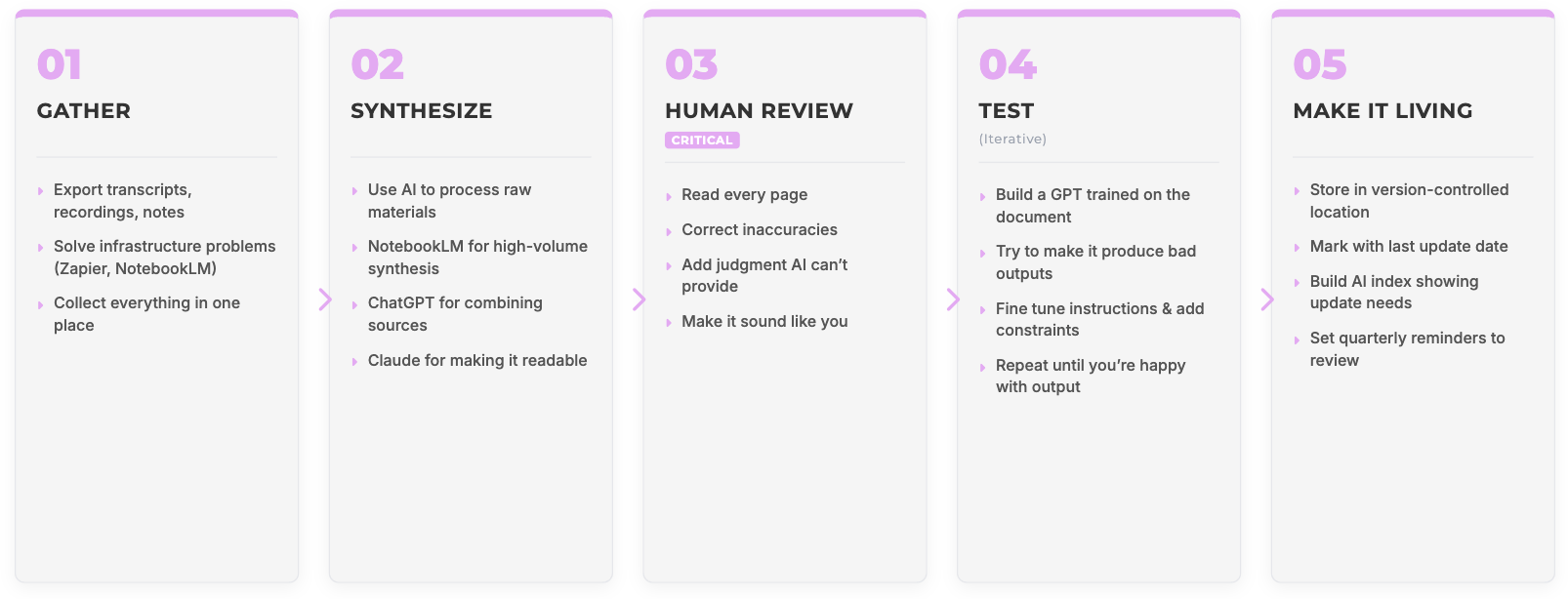
Phase 1: Gather
Export transcripts, recordings, notes
Solve the boring infrastructure problems (Zapier automations, NotebookLM connections)
Collect everything in one place
Phase 2: Synthesize
Use AI to process raw materials
NotebookLM for high-volume synthesis
ChatGPT for combining sources
Claude for making it readable
Phase 3: Human Review (Critical)
Read every page
Correct inaccuracies
Add judgment AI can’t provide
Make it sound like you
Phase 4: Test (Iterative)
Build a GPT trained on the document
Try to make it produce bad outputs
If it succeeds, fine tune your instructions and/or add constraints
Repeat until you’re happy with the output
Phase 5: Make It Living
Store in version-controlled location
Mark with last update date
Build an AI index (grab the template here) showing which GPTs need updating when documents change
Set quarterly reminders to review and update your training documents
What to Do First
If you’re starting from scratch, here’s my recommended order:
Weeks 1-2: Buyer Personas This is foundational. You can’t write good messaging if you don’t know who you’re talking to.
Weeks 3-4: Messaging & Narrative Once you know your buyers, define how you talk to them.
Weeks 5-6: Product Information Ground everything in what you actually do.
Weeks 7-8: Brand & Voice Protect what makes you distinct.
Weeks 9-10: Founder Profile Build a decision simulator for how your CEO thinks and communicates.
Once you build this foundation, everything else goes faster.
The Prompt Templates: Your Starting Point
Everything I described above — the process, the iteration, the specific prompts I used — is detailed in this set of prompt templates you can download and use for yourself.
These aren’t generic “create a persona” prompts. They’re multi-phase prompt chains designed in two phases to separate evidence gathering from interpretation.
Each template walks you through:
What sources to gather first
Which prompts to run in which order
How to move from data extraction to synthesis
When to add human review
How to test the outputs
The templates cover all five core documents:
Buyer Persona Prompts — Extract value patterns, buying triggers, and decision dynamics
Messaging Prompts — Build from value claims through to narrative constraints
Product Audit Prompts — Create exhaustive, accurate product documentation
Brand Voice Prompts — Define voice through extraction and codification
Founder Profile Prompt — Build a communication and decision model
💡You can download the complete set of prompt templates here.
Use the training documents they generate as the living foundation of your AI strategy, not as a one-time exercise. Run them when onboarding new leaders. Revisit them after strategy shifts. Update them as your product, positioning, or voice evolves.
Why This Matters
In an AI-first organization, the bottleneck isn’t output — it’s discernment. You can produce infinite content, but it will be meaningless slop without the right guard rails.
These five training documents are how you scale while preserving accuracy, quality, and brand distinctiveness. They’re how you ensure that even when you’re moving fast, automating aggressively, and not personally reviewing every output, the work still reflects the judgment that would have shaped it if you were.
Before you hire your next marketer, build your next GPT, or automate your next workflow, build these five documents. They’re the work that makes everything else easier, faster, and more impactful.
— Kathleen
Tools, Platforms & Resources Mentioned
Fathom – Customer and prospect call recordings
Zapier – Automations for bulk data export
NotebookLM – Processing large volumes of source material
ChatGPT – Building custom GPTs and daily synthesis
Claude – Long-form, natural-sounding writing
Manus – Scheduled recurring tasks
AI Use Decision GPT – Framework for when to use AI vs. humans
AI Index Template – Single source of truth for your training documents and GPTs
AI Training Document Prompt Templates – The exact prompts I used to build all five of the training documents detailed here
💜 A note on my content:
Yes, I use AI to help me write this newsletter. Every idea, insight, and point of view here is mine. AI helps me think, structure, and draft — it does not replace my judgment. I also use em dashes (and emojis 👀) unapologetically, sometimes because AI likes them, and sometimes because they’re grammatically correct. If you’re here to sniff out “what was written by AI,” you’ll probably be disappointed. And if you’re fundamentally against the use of AI in writing, this newsletter is likely not for you. You’ll find this disclaimer in every issue, because transparency matters to me.
This is a great post! Thank you for taking the time to document and share your process.