

I Accidentally Created AI Sprawl
So I Built an Operating System Instead

When I joined Sequel 3 months ago, everything was moving fast.
Not “we’re aligned and executing” fast. More like: there is no time to ease into this fast.
I felt pressure to show impact immediately — and AI was the lever sitting right there.
So I pulled it.
Hard.
In my first few weeks, I did what a lot of experienced operators do when dropped into a new environment with high expectations: I started building.
Training documents.
Custom GPTs.
More training documents.
Even more GPTs.
Anything that helped me get answers faster, draft smarter, or reduce cognitive load felt justified.
And for a while, it worked.
Then, in the last few weeks, I realized I’d created a mess.
How It Started
When I joined Sequel last fall, one of the biggest questions in front of me was how to use AI, not whether to use it. That wasn’t really a question. I was coming in as the first head of marketing for a function that had previously been led by our founder, who’s also a trained marketer. It was a small team moving fast and getting great results (so much so that we ended 2025 having 3X’d our year-over-year growth).
But alongside all of the growth the company was experiencing, there was also significant product marketing debt, the messaging hadn’t kept pace with the innovation happening in the product, and we had a lot of tribal knowledge — things that lived in people’s heads about our ICP and the personas we served, the types of deals we won, and how we actually talked about the product.
This worked fine when everyone sat in our San Francisco office and could trade information by looking across the room. But the team was growing. I was remote, and so were several other new hires. We needed to start codifying things.
I took this on myself during onboarding, mostly because I knew it would help me succeed. I took copious notes in every conversation during the interview process. Who our buyers were. What deals we won and why. How people internally talked about the product. What the founders’ vision was for where we were headed.
I kept doing this through my first few weeks. Writing everything down. Recording calls when I could. Dumping it all into a ChatGPT Project I’d created for Sequel. Inside that project, I organized conversations by team and topic. One for product marketing. Another for messaging. One for the BDR team that reported to me. Another for product and roadmap. Each conversation built on the previous ones, so ChatGPT got smarter every time I added something new.
But the information was unstructured. So I started taking everything from those conversations and building training documents so that I wouldn’t have to reinvent the wheel every time I created a new prompt or built a new GPT. At first, I did this just for myself as a way to remember, at scale, all the information coming at me. It felt like drinking from a firehose, but AI made it manageable. I felt organized and in control.
This was all happening while we were launching a new product almost every week. Then in December, we sprinted through twelve new product launches in twelve days.
That sprint forced my hand. To prepare for it, I needed to document as much as possible, as quickly as possible. So I built my first set of custom GPTs to help execute the launches.
Here’s the thing: we don’t have a full-time product marketer. When I joined, I asked our CEO to hold off on hiring one until I could see how far we could push product marketing with just AI and our lean team. I wanted to understand what was possible to automate and scale, so that when we did eventually hire someone, I’d know exactly where to focus them — on the highest value work where human expertise and judgment actually mattered.
The result was that we went through all of Q4 without a product marketer. Just our small but mighty marketing team along with a team of GPTs doing all of the product marketing work required to support our launches.
Looking back, I’m kind of amazed at what we accomplished. I’m so thankful I had AI to help. But I also recognize that under the surface, what felt helpful was quickly becoming overwhelming.
The Breaking Point
Three months into my role at Sequel, I looked at my Google Drive and realized I’d created a disaster. Not the kind anyone else would notice. Everything looked organized on the surface. But I knew the truth.
I had seven different training documents about our ICP and personas. At least six on messaging. More than twenty on the product. Some contradicted each other. Some said basically the same thing with slightly different emphasis. Each one was written during a different week when I was trying to get smart on a different part of the business, getting feedback, and iterating on my work.
This happened because I needed to move fast. When you join a startup as the first marketing leader, you don’t get a grace period. The CEO hired you to make an impact, and everyone is watching to see what you’ll do.
So I did what I always do when I need to get up to speed quickly. I put my head down and did the work, and that included building several custom GPTs including a Synthetic Buyer GPT, a Messaging Expert GPT, a Product Launch Expert GPT. Then some more specialized internal ones: an AI Use Decision GPT to help me figure out when to use AI and when not to. A Tracking URL Generator because I got tired of manually building UTM parameters. A Software Purchase Business Case Builder for when we needed to justify buying new tools.
I used these things constantly for things like writing website copy, writing emails, getting feedback on messaging, putting together product launch assets, and building sales enablement materials. Each GPT needed training content, so I’d write a quick document about whatever I’d just learned, upload it, and move on to the next fire.
It worked, in the sense that I was productive. I shipped messaging, I wrote product launch briefs. I built out thought leadership content. But I was also building something I didn’t quite see yet: AI sprawl.
The reckoning came when I finally landed on our messaging. After weeks of iteration, I’d built an approved messaging house that felt right. Solid. The thing we’d rally around as a company.
Then I realized what came next. I needed to go back and update all the GPTs I’d built with this new messaging. And I had no idea where the old messaging lived — which of the six messaging documents each GPT was using, which versions were active and which were outdated. I’d have to open each GPT, check its training files, and figure out what needed replacing.
Around the same time, we started planning for a hiring wave — sales team, customer success, and eventually marketing people. I’d need to onboard them quickly, which meant I’d need clean, consolidated materials on our ICP, our buyer personas, and our messaging — the kind of stuff new hires could actually learn from.
I looked at my seven persona documents and six messaging documents and twenty-plus product documents and thought: there is no way I can hand this to a new employee.
That’s when I knew I needed an actual system.
Not a folder structure. Not better naming conventions. A real operating system for how I work with AI.
My AI Operating System
I started thinking about it in three layers.
The first layer is what I’m calling Source of Truth. These are the training documents. I keep them all in a single Google Drive folder so they’re easy to find and keep updated.
The second layer is Interfaces, the custom GPTs that people actually use to get work done. These live in Sequel’s corporate ChatGPT instance and are shared with all users.
The third layer is Workspaces, the ChatGPT Projects where messy, in-progress thinking happens. These are shared on a team-by-team basis.
Once I had that mental model, the work became clearer. I went through every training document I’d created and add metadata headers — just a few lines at the top of each one covering:
Who owns it
What it’s for
Which GPTs use it
When it was last reviewed
When it needs to be reviewed next
Whether it’s active or should be retired
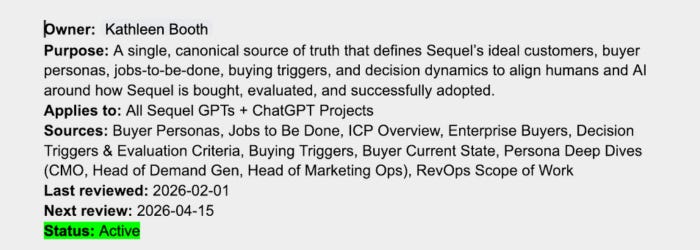
Sounds simple, but it took longer than I thought it would because I had to actually open every document and remember why I’d written it in the first place. This was actually a good exercise to go through because it forced me to think through whether each document should still exist on a stand alone basis, could be combined with another document, or was simply outdated and could be deprecated.
Once I went through and cleaned everything up, I built an index in the form of a Google Sheet with two tabs:
One tab lists all the training documents with their purpose, status, and links to each document
The other lists all the GPTs, what training docs they use, and who owns them.
The whole point is that anyone in the company should be able to look at this index and immediately see what we’ve built, what they can use, and where to find the approved training content if they want to build their own GPT or use the information somewhere else.
💡Build your own index using this template - simply make a copy and fill in with your own information.
AI Spring Cleaning
Building the index revealed the real problem — I had way too much duplication.
So I started consolidating. I took all seven ICP and persona documents and dumped them into ChatGPT. I asked it to find contradictions, and it found plenty. Then I told it which information to prioritize, which sources to treat as primary, and had it write one consolidated version.
Same thing with messaging. Six documents became one.
The product information was different. I actually ran a deep research project where I had AI go through our entire website, help docs, blogs — basically everything I could give it — and it produced a 50 page master training document on the Sequel platform. Now, every time we release something new, I add a section to that document detailing the new feature or functionality we’re releasing. This isn’t just useful as an AI training document — it’s quickly becoming the most complete reference on what Sequel actually does that exists anywhere, which makes it incredibly useful for getting new team members up to speed quickly (timely given that we’re in the process of hiring for several sales and CS roles).
Once everything was consolidated and indexed, I set up a recurring quarterly task in our project management system (we use ClickUp) to review each training doc and GPT and make sure nothing goes stale. That was the part I’d been missing before. I’d create these things and then forget about them, and they’d drift.
What I have now isn’t fancy, but it’s organized. I know what training content exists, where it lives, what it’s used for, and when it needs to be refreshed. I know which GPT does what job and which training sources it relies on. I know when to use a custom GPT versus when to just work in a Project.
What The Mess Taught Me — And What’s Next
I’m writing this partly to document what I built, but mostly because I want to remember something. The mess I made wasn’t a mistake — it was necessary. You can’t clean up something that doesn’t exist yet, and you can’t organize what you haven’t created. This is my way of saying, don’t let the need to have a system or get organized slow you down. Go build!
But there’s a moment when all of that accumulation has to turn into something more organized — when you have to stop building and start editing. In my case, I hit that moment around day ninety.
I’m still building. We’re moving too fast to stop. But now, when I create a new training document or GPT, I immediately add it to the index and I give it a metadata header. I think about what it might duplicate and whether consolidation makes sense. The system doesn’t eliminate messiness, but it gives me a structure to catch it before it gets too out of control.
My system is working well for me, but the real test of it will be whether other people within the company start using it. Whether the sales team actually adopts the GPTs I built for them. Whether new hires find the training docs helpful. Whether anyone suggests improvements to the index or points out gaps.
If that happens, I’ll know the system is working.
Tools, GPTs & AI Platforms Mentioned
Here’s a list of the tools, platforms, and custom GPTs referenced in this issue. I’ll include a version of this list at the end of every newsletter.
AI Index - A Google Sheets template for building an index of training documents and custom GPTs. Make a copy and use it for yourself.
A note on my content:
Yes, I use AI to help me write this newsletter. Every idea, insight, and point of view here is mine. AI helps me think, structure, and draft — it does not replace my judgment. I also use em dashes (and emojis 👀 ) unapologetically, sometimes because AI likes them, and sometimes because they’re grammatically correct. If you’re here to sniff out “what was written by AI,” you’ll probably be disappointed. And if you’re fundamentally against the use of AI in writing, this newsletter is likely not for you. You’ll find this disclaimer in every issue, because transparency matters to me.