

The Zero CAC Employee
Show up on LinkedIn like a human. Scale like a system.

I was recently building out an influencer marketing strategy for Sequel, and one of the first things I did was go looking for who to actually target as influencers for the campaign. I specifically wanted marketers, director-level and above, who are in full time, in-house marketing roles who’d also built a real personal following on LinkedIn.
I expected a long list. I got a VERY short one.
There are plenty of people with big LinkedIn followings talking about marketing. But almost all of them are professional influencers or consultants who are looking to monetize their presence through selling courses or a consulting practice or paid subscriptions to a newsletter. No shade to any of them — it’s a great and very lucrative way to make a living — but that didn’t happen to be the profile I needed for this campaign.
What I couldn’t find were many people with full-time jobs, still doing the work, who’d also built an audience — just because.
That gap is IMHO a huge missed opportunity I want to talk about this week because it’s also one of the best examples of where combining human branding with agentic systems holds tremendous potential to unlock ROI.
Why the gap exists
I have some theories about why there aren’t more in-house marketers building personal brands on LinkedIn.
Some people don’t feel like they have time for it.
Some don’t feel like they need to, because their job is going fine without it.
Some work somewhere that doesn’t encourage it, or actively discourages it.
A lot of people just think it’s cringy (I’ve heard this one more than any other).
I understand all four of these reasons and have personally felt some version of each of them. But I think they’re all wrong, and the data backs me up.
The “Zero-CAC Employee”
For the past few years, I’ve heard Cassie Young, a General Partner at Primary Venture Partners, talk about the idea of a “zero CAC CEO” — a founder whose reputation and network are so strong that they can get real customer access with almost no paid acquisition. A rolodex of prospects who already trust them, as Primary’s own investment thesis puts it.
Here’s the part I find more interesting than the label itself. Cassie has walked it back. She’s said publicly that she’d been “up on my soapbox” about the idea, and that she thinks she over-rotated on it. Her current position is that founder distribution “may get you in the door,” but that’s just not enough on its own. It has to be paired with real product substance, technical depth, and the ability to actually deliver for the customer once you’re in the room.
I think that’s exactly right, and I think it applies well beyond founders.
The access-without-substance version of a personal brand doesn’t really work, and it’s most of what makes LinkedIn feel cringy to the people who hate it.
But the reverse is also true. Real expertise with zero public presence is a little bit like that proverbial tree that fell in the forest. If you weren’t there to see it, did it really happen?
The individual who’s actually good at the job, and is also visible about it, is the one compounding an asset almost nobody else in their seat is building.
Inspired by Cassie, I’ve been calling that person a “Zero-CAC Employee”: someone whose personal presence — not the company page, the paid campaign, or the SDR sequence — is doing the work of a growth channel, backed by real expertise. It requires no media spend or agency retainer. Just consistent, credible presence, which builds compounding audience and trust.
A Zero-CAC Employee is someone whose personal presence does the work of a growth channel — no media spend, no agency retainer, just consistent, real presence, leading to compounding audience and trust.
I’ve been one of these, in one form or another, for about a decade. I just didn’t have the language for it until now.
I’ve been doing this since before it had a name
I started building a following on LinkedIn back when I owned an agency and was also, out of necessity, its chief salesperson (running a small agency will teach you real fast that nobody else is going to build your pipeline for you). I wasn’t doing it to build a following. I was doing it because it was one of the only lead gen channels I could afford.
Ten-ish years later (**cough** yes, it’s been a while **cough**), I’m about to cross 50,000 followers on LinkedIn and I’ve never sold a course or used it to drive a consulting business. I built my following purely because I kept showing up, and eventually showing up compounded into something.
I don’t say that to brag. I say it because I think it’s proof of a pattern that more people should be running, and mostly aren’t.
The data doesn’t leave much room for debate
This isn’t just a personal anecdote. Every study I could find on personal versus company presence on LinkedIn points the same direction, even though the exact numbers vary.
Refine Labs compared seven employees’ personal profiles to its own company page and found personal posts got 2.75x more impressions and 5x more engagement, despite those employees having 46% fewer followers on average than the company page.
Metricool’s 2026 study, which looked at 673,658 posts across more than 63,000 accounts, found personal profile engagement at 2.60% versus 1.74% for company pages.
Vulse’s dataset, spanning 150,800 employee posts and 400 million impressions, put employee engagement at 5.7%, versus a company-page benchmark of 0.2–0.4%.
The individual multiple isn’t the same in every study, but the overall direction is consistent
Across three independent studies, personal LinkedIn presence outperformed company pages on engagement — every time
That tracks with what I’ve seen play out twice now, at two different companies.
At Pavilion, a meaningful share of our pipeline traced back to our executives’ and team members’ individual presence on LinkedIn — not the company page. And I’m seeing the same pattern at Sequel today. Despite having a strong, well-run company presence, a large share of the pipeline we generate from organic social comes from individual posts, not the brand account.
To be clear, I don’t think that means the company page doesn’t matter. It means the company page alone isn’t enough, and most companies are still allocating as if it is.
The door opener, and where AI actually fits
Here’s the part of this that ties back to what Code Meets Creed is actually about: balancing AI-first growth with human-first brand.
Go back to Cassie’s framing for a second: the zero-CAC founder’s presence “may get you in the door.” I think that’s the best way to describe what personal presence is actually for. It’s not the whole deal. It’s the door opener. The thing that gets a cold prospect to take the call, gets a former colleague to introduce you, gets someone who’s never met you to reply to your DM because they already feel like they know how you think.
That’s a human-first asset. No AI system builds it for you, and no AI system can fake it convincingly enough to matter over time.
What AI is actually good for is everything on either side of that door opener — helping you build the presence faster, and helping you use it once it’s built.
On the building side, that’s the human-first brand, accelerated. LinkedIn rewards individual people, individual voices, and individual relationships. AI’s job there isn’t to replace the person doing the showing up, it’s to remove the friction that stops most people from doing it consistently.
That’s the problem I built a tool to solve for myself.
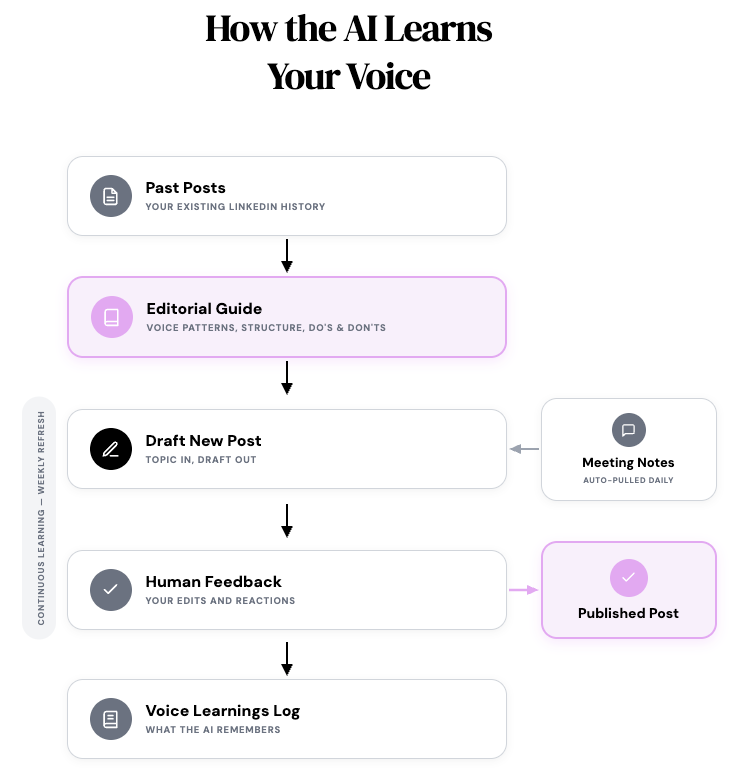
I have a LinkedIn skill that runs as part of my personal operating system. Every morning, it reads my Granola meeting transcripts from the day before, cross-references my point-of-view “brain” (a running store of my positioning and opinions), and looks at the performance history of my past posts — all of which live in a Supabase table I’ve been exporting to for a while now. From that, it generates five or six draft concepts, tuned to the formats that have actually performed well for me historically.
I pick whichever one resonates most, use it as a starting point, and then write the post myself. It’s not writing my posts for me — it’s clearing the blank-page problem, which was always the actual bottleneck. It produces decent first drafts, but I edit heavily. And it gets smarter the more I use it: every time I edit a draft before publishing, that edited version feeds back into the system, so it keeps learning my actual voice instead of a rough approximation of it.
💡Build your own LinkedIn Post Writing Skill using my instructions
That’s AI-first growth doing exactly what it should: accelerating the human-first thing, not replacing it.
Here’s the part I think most people miss, and it’s the part that loops this whole thing back to pipeline.
The LinkedIn presence you build on the front end doesn’t stop paying off once someone notices you. It also does work on the back end, when you’re actually trying to close the deal. If you’ve spent years building a real network, you already have warm paths into accounts that would otherwise require six touches from an SDR just to get a reply. The problem has always been that this knowledge lived in your head. You’d remember, maybe, that you know someone at a target account, if you happened to think of it at the right moment.
That’s now a solvable problem, and it’s starting to get genuinely programmatic. Relationship activation platforms like Smallworld (full disclosure, I’ve been advising them for a few years, but am also a huge fan of what they’re building) are built to mine your (and your team’s) existing network via your LinkedIn connections, email history, and CRM data and surface who on your team already has a real relationship at a target account so you can multi-thread a deal using actual warm paths instead of cold outbound.
That’s the second half of the story and the piece I think all those people saying posting on LinkedIn or building a following there is “cringy” are missing.
The audience and network you build on the front end through a real, human-first presence becomes an asset your revenue team can activate on the back end, systematically, instead of relying on someone happening to remember they know a guy.
Build the presence because it’s human-first and it’s the right way to show up. Then let AI find where that presence already has doors half-open, and go knock on them.
The takeaway
I think you can extend Cassie Young’s zero-CAC CEO idea to every seat in a company, not just the top one — with the same caveat she’d add: presence alone isn’t the whole game, it’s the door-opener.
What you do once you’re in the room is what compounds it. I think of myself these days as a Zero-CAC CMO — I have a full-time job I love, I’m still not selling anything on the side, and I’ve watched my presence generate pipeline for two companies now, not because I set out to build a personal brand, but because I kept showing up, sharing what I’m learning and observing, and engaging with others.
If you’re a marketer, an operator, an IC, or anyone with real expertise and a full-time job — you’re sitting on a channel most of your peers aren’t using. It’s not hard, and what’s crazy is that almost nobody with a full time, in house job is doing it consistently, which means the bar to stand out is lower than you think.
And the payoff isn’t just theoretical or on some future timeline. It’s not just top-of-funnel awareness. Build it right, and it’s an asset your whole revenue team can eventually activate to close what’s already in motion.
If you want to test this yourself, pick one platform, post consistently for 90 days, and actually track what happens to your inbound. Not your follower count — your inbound. That’s the number that tells you whether this is working.
People, tools and resources mentioned in this issue
Some of the links in this issue may be affiliate links, which means I could earn a small commission if you sign up through them. That never changes what I recommend. I only mention tools I’ve personally used and have in my own regular workflow — not tools I was pitched or paid to feature. If it’s in this newsletter, it’s because I’d be using it whether or not there was a commission attached.
Cassie Young, “Primary’s 2026 investment thesis for GTM Tech,” Primary Venture Partners (Feb. 2026)
Cassie Young, “How Cassie Young Picks Winners Early”, GTMnow podcast (Dec. 2025)
Refine Labs, “Personal LinkedIn Profiles Outperform Company Pages with 5x More Engagement” (2026)
Metricool, “2026 LinkedIn Statistics for Social Media Marketers”
Vulse, “LinkedIn Algorithm: Employee Posts Get 14x More Engagement” (2026)
Code Meets Creed issue on how to build your own personal operating system
Supabase (open source PostgreSQL relational database)
Smallworld AI (relationship activation platform for multithreading and warm intros)
💜 A note on my content:
Yes, I use AI to help me write this newsletter. Every idea, insight, and point of view here is mine. AI helps me think, structure, and draft — it does not replace my judgment. I also use em dashes (and emojis 👀) unapologetically, sometimes because AI likes them, and sometimes because they’re grammatically correct. If you’re here to sniff out “what was written by AI,” you’ll probably be disappointed. And if you’re fundamentally against the use of AI in writing, this newsletter is likely not for you. You’ll find this disclaimer in every issue, because transparency matters to me.