

How I Actually Learn AI
The courses, communities, newsletters and podcasts worth checking out

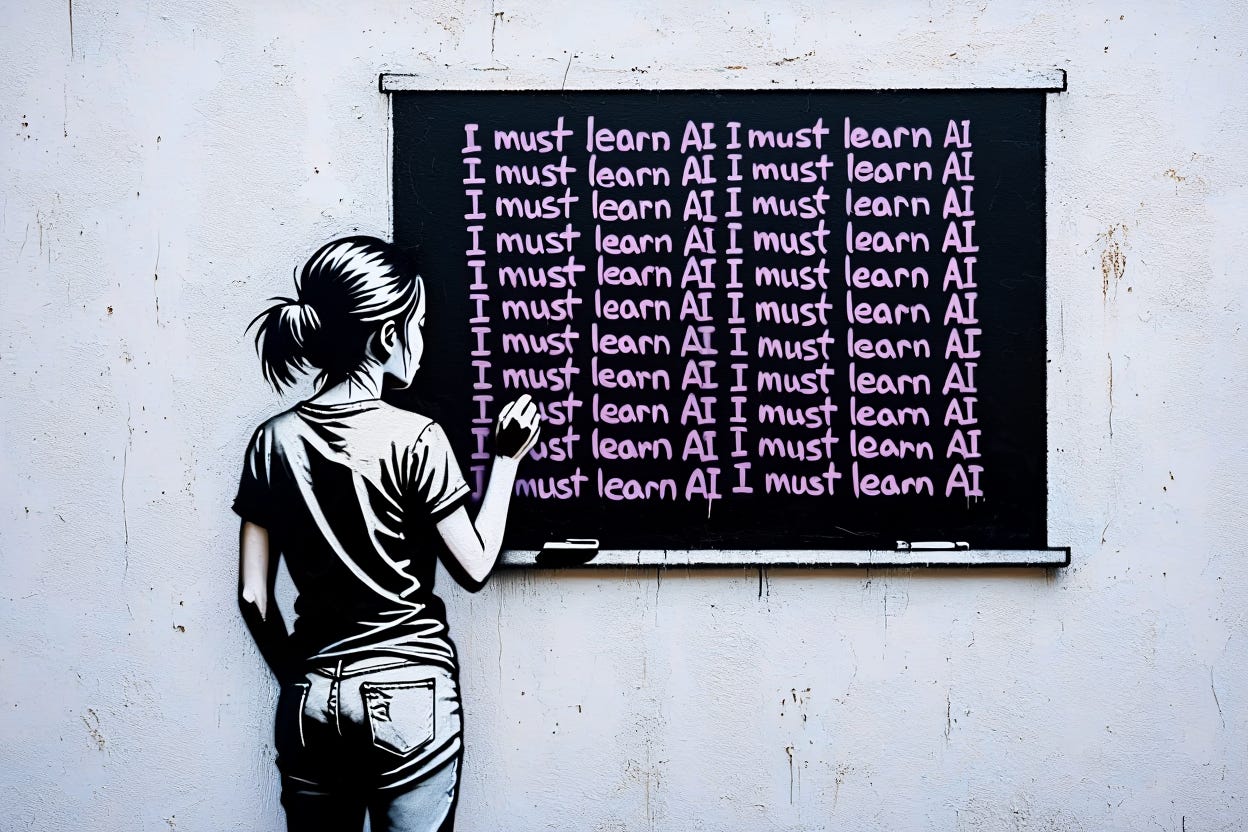
There’s a specific feeling I get when I’m scrolling LinkedIn and someone posts about how they’ve replaced half their team with AI agents, or rebuilt their entire go-to-market motion with autonomous workflows, or shipped twelve new products in a week using nothing but prompts and vibes.
It’s the same feeling teenagers get when they scroll Instagram and see someone who looks perfect — the flawless skin, the tiny waist, the life that looks effortless. And then they feel terrible about themselves by comparison.
The thing is, those people probably had plastic surgery. They definitely photoshopped the picture. They don’t actually look like that.
The AI version of this is everywhere. And I don’t believe half of it is real. But it creates the same effect — a sense that everyone else is further along than you are, that you should be doing more, moving faster, building more aggressively.
I’ve felt it too.
I’m feeling it less now, but only because I’ve made a deliberate decision about how I want to learn and what I’m trying to accomplish.
You don’t have to keep up with everything
The first thing I want to say is this: you don’t have to master everything. You can’t, and trying to will burn you out before you build anything useful.
What you do need is general awareness — what the tools do, how they’re used, where they’re heading. And you need enough hands-on time to develop real instincts about how the tools work and what they make possible. But you don’t have to be an expert in any one thing. You can be moderately good at a lot of things and still create enormous leverage for yourself and your team.
That said — and I want to be honest here — I do think you need to stay current if you want to remain competitive. That’s just my opinion, but I believe it.
The marketers who are building real fluency right now, even imperfect and messy fluency, are going to have a meaningful advantage over the ones who are waiting until things settle down.
Things are not going to settle down.
Learning by doing
Everything else I’m about to share matters a lot less than this one thing.
The single most effective way to learn AI is to get into the tools and use them.
Not watch someone else use them. Not read about how someone else uses them. Actually open Claude or ChatGPT or whatever you have access to and start solving real problems — personal ones, professional ones, small ones you’ve been putting off. See what happens. Make mistakes. Try something that doesn’t work, figure out why, and try something different.
This is how you ensure what you’re learning sticks with you.
If you can do this in tandem with a tutorial or a YouTube video — great. Use that to avoid mistakes you’d otherwise make. But the tutorial without the hands-on practice is almost worthless, whereas the hands-on practice without any guidance still produces real learning.
That’s the job right now — build something, see if it works, iterate.
The learning stack
Beyond hands-on practice, here are the sources I actually learn from. I’ve started calling this my “AI learning stack” — five channels that reinforce each other.
Channel 1: Structured courses with community. The key word here is “with community.” A course you take alone is better than nothing, but a course you take alongside peers who are solving the same kinds of problems is significantly better. Three programs I’d put in this tier:
The Marketing AI Institute for basic AI fluency specific to marketing
Pavilion for AI courses taught by go-to-market practitioners — people solving the same problems you’re solving
Trust Insights Academy (along with their Analytics for Marketers community) with Christopher Penn for the more technically rigorous AI for marketers
All three wrap their curriculum in active communities. That matters because when you’re struggling with something, you find out fast that most people are no further along than you are (which is, honestly, a relief).
Channel 2: Newsletters and podcasts. There are countless newsletters and podcasts about AI. Certainly too many to name here. I only have the time and mental bandwidth to regularly follow a few. Here are the ones that make the cut:
Emily Kramer from MKT1 (newsletter)
GTMnow by Sophie Buonassisi of GTM Fund (newsletter)
Marketing Against the Grain by Kieran Flanagan and Kip Bodnar (podcast)
On the Edge by Jordan Crawford (newsletter)
Channel 3: Social media — specifically X. I know. I don’t love it either. But most of the sharpest AI minds are active there, and that’s where the most detailed build documentation gets shared. It’s where I find the best breaking news on new developments, the most specific instructions on what people are actually building, and the most honest takes on what’s working and what isn’t. I have a swipe file of tweet threads I’ve bookmarked and want to execute on — and it just keeps getting longer.
Channel 4: Peers and mentors who are one step ahead. You don’t need someone who’s five years ahead of you — you need someone who figured out the thing you’re trying to figure out six months ago. I’ve learned enormously from Maddie Bell at Synapsa, Liza Adams, Nicole Leffer, Jonathan Kvarfordt, Jonathan Moss, Andy Jolls, and Elaine Zelby, who runs Tofu. I’ve also learned from our CEO at Sequel, Oana Manolache, who is constantly building things and solving for the team’s needs.
Find the people who are a step ahead and stay close to them. Watch what they build. Ask them what didn’t work.
Channel 5: Your own team. I’ll come back to this one.
The communities worth your time
I want to separate this out because I think communities often get lumped in with courses, and they’re different.
In addition to Pavilion, the Marketing AI Institute community, and TrustInsight’s Analytics for Marketers Community, I’ve benefited greatly from The AI Exchange community, which meets every Friday and is specifically designed to surface practical use cases and lessons learned, as well as CMO Coffee Talk which has an active AI channel.
All of these are worth a closer look if you’re in marketing leadership and looking to learn more about AI. The value isn’t in the content — it’s in realizing that your peers are all figuring this out in real time, just like you. Nobody has this solved. The people who look like they do on LinkedIn mostly don’t.
The problem with single-player AI
Most AI learning right now is happening in silos. An individual marketer discovers a great way to use Claude for competitive research. A content writer builds a killer prompt for repurposing webinar transcripts. An ops person automates a reporting workflow that used to take half a day.
These are real wins for the people who built them, but they’re not being shared. They’re not being scaled. They’re not being turned into team capability. They’re staying on one person’s laptop or in their own AI prompt library, and when that person leaves the company or switches roles, the knowledge goes with them.
I wrote about this in an earlier issue — the difference between single-player and multiplayer AI. Single-player is when individuals are building for themselves. Multiplayer is when the team is building together, sharing what works, scaling solutions across the organization.
Most marketing teams are stuck in single-player mode. Getting to multiplayer is one of the things I’m actively working on at Sequel right now. I don’t have it figured out yet, but I know what the building blocks look like.
Single-player is when individuals are building for themselves. Multiplayer is when the team is building together. Most marketing teams are stuck in single-player mode.
How to get to multiplayer
This is where the organizational learning question comes into play.
The first thing you have to do is create the conditions for sharing. People will not spontaneously share what they’re building — they’re busy, they don’t know if it’s worth sharing, they’re worried it’ll seem half-finished. You have to build in the expectation
A few things I’d try, and some of these we’re testing at Sequel:
Group hackathons work because they create a forcing function. Give a team a few hours and a problem and let them build. You’ll surface capabilities nobody knew existed in your team. You’ll also surface the gaps.
Weekly AI learning sprints — dedicating even 30 minutes a week to one specific skill or tool — create consistency. The hardest thing about learning in a fast-moving environment is keeping up a habit when there’s always something more urgent. The sprint protects the time.
Show-and-tells are probably the highest-leverage thing you can do. One person, 10 minutes, showing the team what they built and how it works. This does three things: it forces the builder to articulate their thinking clearly, it gives everyone else something concrete to steal, and it gradually builds a shared vocabulary and set of standards across the team.
The goal isn’t to have everyone doing the same things. The goal is to stop losing institutional knowledge the moment it’s created.
Where I’d start
If you’re feeling behind, here’s what I’d actually tell you to do.
Pick one tool — Claude, ChatGPT, doesn’t matter which — and use it every day for two weeks on something real. Not a tutorial problem. An actual work problem. See what happens.
Join one community. Start with the AI Exchange or Pavilion if you’re in B2B marketing. Watch what other people are sharing. You will feel less behind within a week.
Then, if you’re a team leader, run one show-and-tell. Find whoever on your team is already experimenting and ask them to show you what they built. Then make it a thing. Do it again next week.
That’s it. That’s the stack.
The comparison trap is real, and it’s not going away. But the people posting about their AI-autonomous companies are mostly selling something. The actual work is messier and more interesting than that.
— Kathleen
Tools, platforms & resources mentioned in this issue
Marketing AI Institute — Courses and community for marketers building AI fluency; strong community layer.
Pavilion — B2B professional community with practitioner-taught AI courses focused on go-to-market use cases.
Trust Insights Academy — Christopher Penn’s AI education organization; rigorous and technically grounded.
AI Exchange — Community organized by marketing-forward CMOs; meets weekly to share AI use cases.
CMO Coffee Talk — Marketing leadership community with an active AI channel.
MKT1 — Newsletter by Emily Kramer covering marketing strategy and growth.
GTMNow newsletter — GTMFund’s newsletter on go-to-market strategy.
Marketing Against the Grain Podcast — Kieran Flanagan and Kip Bodnar on AI use cases and marketing strategy.
💜 A note on my content:
Yes, I use AI to help me write this newsletter. Every idea, insight, and point of view here is mine. AI helps me think, structure, and draft — it does not replace my judgment. I also use em dashes (and emojis 👀) unapologetically, sometimes because AI likes them, and sometimes because they’re grammatically correct. If you’re here to sniff out “what was written by AI,” you’ll probably be disappointed. And if you’re fundamentally against the use of AI in writing, this newsletter is likely not for you. You’ll find this disclaimer in every issue, because transparency matters to me.
Nice list. I would also add this newsletter from Austin Hay: https://growthstackmafia.com/