

Building Community That Actually Converts
And Why You Can't Solve Community With AI


Most of what I write in this newsletter lives on the “Code” side of the equation — AI tools, workflows, agentic systems, the infrastructure I’m building at Sequel. But Code Meets Creed was always meant to be about both halves. Issue 8 was my first real foray into the Creed side, making the case for human-first brand in an AI-saturated market. This issue goes deeper into one of the most powerful — and most misunderstood — expressions of that philosophy: community. I’ve spent the better part of a decade building communities at scale, and here’s what I’ve learned.
I recently gave a talk at the B2BMX conference called “Building Community That Converts.” I’ve also spent the past few months answering versions of the same question from marketers at dinners, roundtables, and on podcasts: how do you actually build community — not just an audience dressed up to look like one?
The question matters more right now than it ever has — and not because community is trendy. If anything, the interest in community is a market correction, not a trend.
The channels most B2B marketing teams have relied on for the past decade are getting measurably harder to execute.
Cold outbound response rates are falling quarter after quarter. Deliverability is deteriorating. Customer acquisition costs keep climbing across paid and events. And the buyer journey has quietly restructured itself: buyers are doing more self-serve research before they engage with any vendor, making attribution harder and vendor influence lower. By the time a buyer talks to sales, they’ve already formed a significant opinion about which vendors are worth their time — and that opinion was shaped almost entirely by sources the vendor didn’t control.
The playbook that worked in 2018 is producing diminishing returns in 2026. This isn’t a temporary dip. It’s a structural shift in how buying decisions get made. And it’s happening for a reason that should be familiar to anyone who has ever made a significant purchase: buyers trust peers more than they trust vendors.
Community is the strategic response to that reality. It’s not a replacement for demand generation. It’s the thing that makes demand generation work again — by building the trust that turns cold outreach into warm conversations, and attention into relationships.
But only if you understand what community actually is.
Audience v. Community
Let me start with the thing I find myself saying over and over in every conversation about this topic:
There is a difference between an audience and a community, and that difference is everything.
An audience is a group of people you send messages to. It’s one-to-many, broadcast-driven, and built around your content. When you stop publishing, engagement collapses. Your newsletter subscribers, your webinar registrants, your social followers — these are audiences. There’s real value in building them. But they are not communities.
A community is what happens when the people in your audience start talking to each other.
That’s the shift. Not one-to-many, but many-to-many. Not broadcast, but relationship. The brand facilitates rather than dominates. And critically, the members get value from each other — not just from you.
When I was at Pavilion, running marketing for the world’s largest private community of go-to-market executives, this distinction was viscerally clear. Pavilion had 10,000 members in a Slack community, and the reason people stayed wasn’t because of the content we published or the events we ran — though those mattered. They stayed because of the relationships they built with other members. Because they were part of something that said something about who they were professionally. Pavilion is one of the rare cases where the community literally is the product. Membership is the value exchange.
Most B2B companies aren’t building that kind of community. They’re building audiences and calling them communities. And then they wonder why the pipeline impact never materializes.
The test is simple: if your brand stopped showing up tomorrow — no more content, no more events, no more programming — would the members keep talking to each other? If the answer is no, you have an audience. If the answer is yes, even hypothetically, you’re building something real.
Community Is Not a Slack Channel
I say this in almost every conversation I have about this topic, and I’ll say it here:
A community is not a Slack channel.
A Slack channel is where some communities happen to gather. It’s a platform, not a community. The community exists — or doesn’t — regardless of where it meets.
What actually makes an audience a community comes down to four things that have nothing to do with technology:
Shared identity. Members define themselves, at least in part, by belonging to it. The community says something about who they are — their professional values, their role, their approach to their work. This is why Pavilion works: being a Pavilion member means something to people. It signals that you are a senior go-to-market leader who takes professional development seriously, values peer learning over vendor relationships, and operates at a certain level.
Peer-to-peer value. Members get value from each other, not just from the brand. If all the value flows from the company to the member — content, events, resources — you have a very good audience program. Community is what happens when members start providing value to each other: introductions, advice, shared experience, mutual accountability.
Consistent engagement. It’s not a list you broadcast to. It’s a space people return to, and the reason they come back matters. A community that only activates around events isn’t a community — it’s an event series.
Platform agnostic. Community can live in Slack, in a dinner series, in a virtual program, in a private forum, or across all of these simultaneously. The platform is a vessel, not the community itself. This also means community isn’t constrained to any single format — the best community programs move fluidly between virtual and in-person, between structured programming and informal connection.
Community Is Not a Channel. It’s the Connective Tissue.
This is probably the most important reframe in this entire issue, and the one that most marketing teams get wrong.
Most companies treat community as one of their channels — another line item on the marketing plan sitting alongside paid ads, content, events, email, and outbound. They measure it with channel metrics: attendance, engagement rate, leads generated. And because community doesn’t produce the same short-cycle attribution as paid media, it often gets deprioritized when the budget gets tight.
This framing fundamentally misunderstands what community is and what it can do.
Community isn’t a channel. It’s the connective tissue of your strategy.
Every channel you run — paid, social, events, email, content, outbound, partnerships — generates attention. Someone sees your ad. Someone opens your email. Someone attends your webinar. That’s attention. It’s valuable. But it’s also ephemeral and rented. The moment you stop paying or stop publishing, it stops.
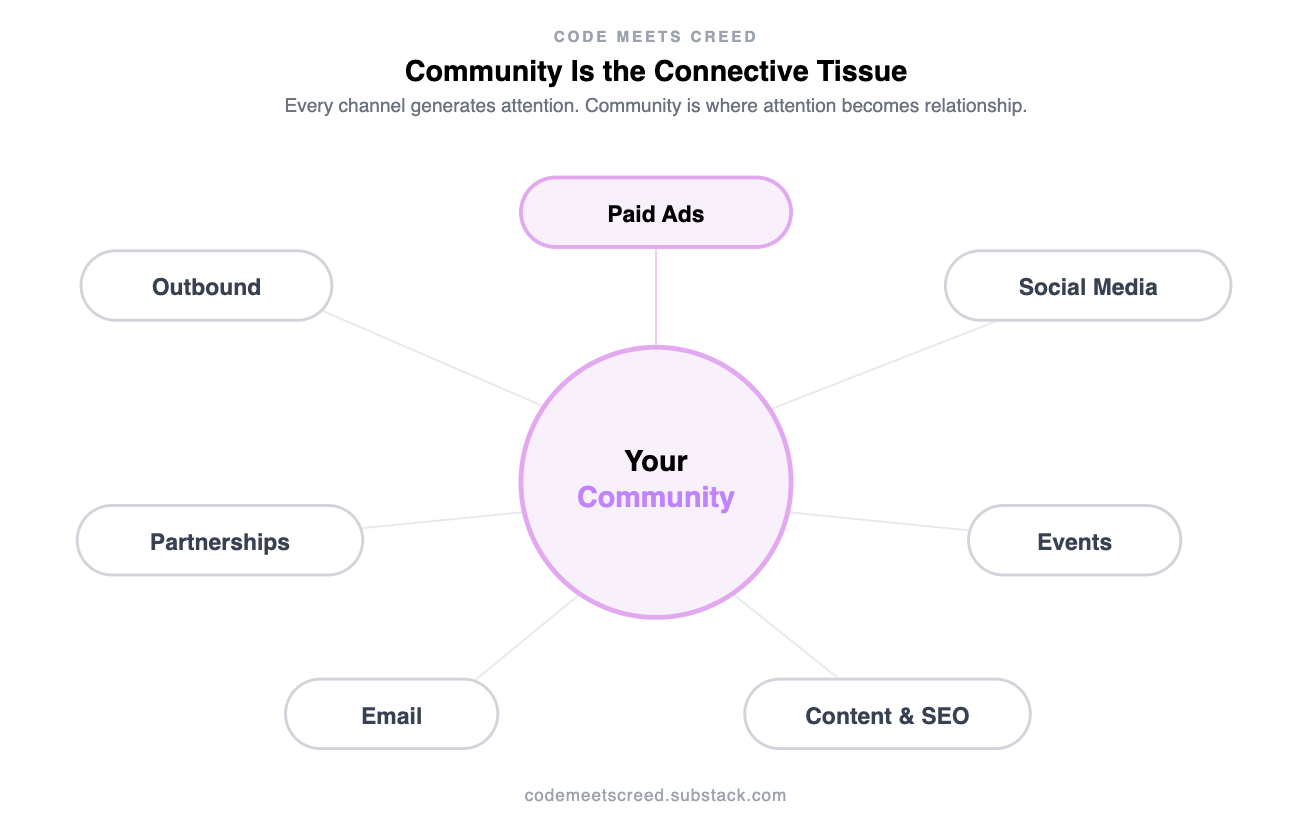
Community is where attention becomes relationship. It’s the mechanism by which someone who found you through a LinkedIn ad becomes someone who trusts you enough to recommend you to a colleague unprompted. It’s the thread that runs through every other channel and gives it staying power.
The question to ask about every channel in your mix isn’t “how do we generate leads from this?” It’s “how does this bring the right person closer to our community?”
The second question fundamentally changes how you design programs, measure success, and allocate budget. And it’s the question that separates the marketing teams building durable competitive advantage from the ones spinning on the demand generation hamster wheel.
Where Does AI Fit In?
Community is one of the clearest examples I know of marketing work that cannot be meaningfully outsourced to AI.
AI can help you identify the right members, analyze engagement patterns, draft invitations, repurpose event content, and surface insights from transcripts. Those are real applications and I use them. But the thing that makes community work — the shared identity, the earned trust, the human judgment about who belongs and why, the moment when a member starts taking ownership — that cannot be generated or automated by AI. Instead, it’s something that grows organically, over time.
This is what I mean by the Creed side of Code Meets Creed. It’s not anti-AI. It’s the recognition that some of the most important and durable competitive advantages in marketing are human by nature. Community is proximity. Proximity creates trust. Trust accelerates pipeline. And none of that chain starts without the human investment that AI cannot replicate.
The companies that win over the next decade will be the ones that use AI to scale their execution and use community to scale their trust. Not one or the other.
The Three Ways to Play
Not every company is in the same position to build community, and not every company should approach it the same way. In my B2BMX talk, I outlined three models — each appropriate for different stages and resources.
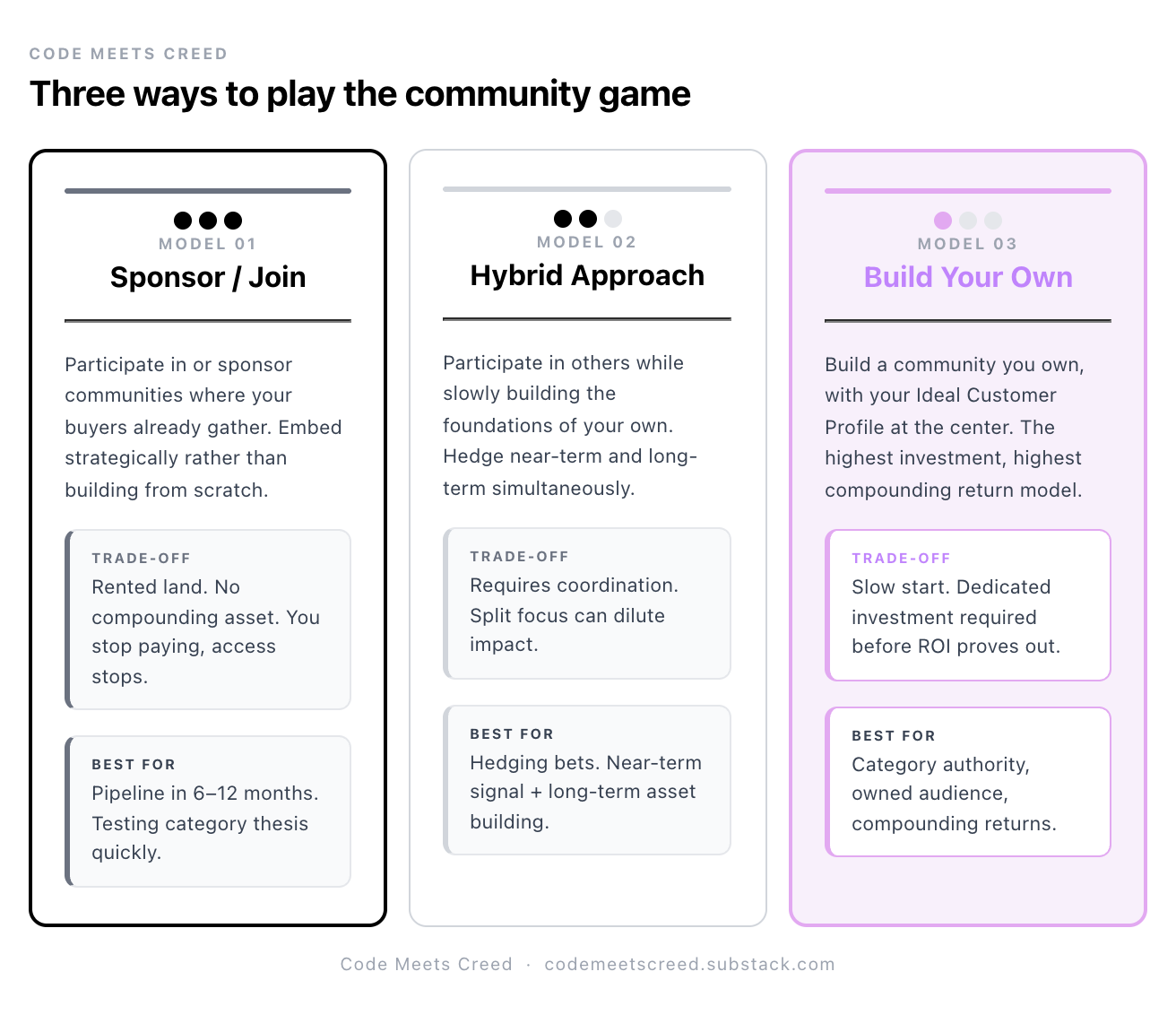
Build your own. This is the most resource-intensive path. You define the ICP, curate membership, program consistently, moderate discussions, and treat the community like a product rather than a channel. It’s right for category creators, companies with long sales cycles, and organizations willing to invest over multiple years before the pipeline impact becomes measurable. The return compounds over time, but the initial investment is real and the timeline to ROI is long. Pavilion is the best example I’ve seen of this done well.
Sponsor an existing community. You don’t own the community, but you embed within it strategically. This works for mid-market and enterprise SaaS companies with strong ICP alignment and executive participation. The key word is strategic — showing up once is brand activity. Showing up consistently, contributing genuine value before attempting to convert, and treating community sponsorship as a capital investment rather than a media buy is what separates the companies that see pipeline impact within one to two quarters from the ones that write it off as brand-only.
Participate organically. The most underutilized model. Early-stage companies or founder-led teams can build genuine trust by showing up authentically in existing communities without formal sponsorship or financial commitment. The financial cost is low, but the time cost is real. The pipeline impact can be fast but narrow, typically driven by warm introductions and referrals. This is where most companies should start before deciding whether to invest in the other models.
The critical distinction across all three:
Sponsoring a community is a media buy. Building a community is a capital investment.
Media buys produce rented attention that disappears when you stop paying. Capital investments produce owned relationships that compound over time. What you’re doing with community depends entirely on which one you’re actually committed to.
What I Learned at Pavilion
I spent nearly three years leading marketing at Pavilion. It was the most concentrated education in community-led growth I’ve ever received — not because Pavilion had it all figured out, but because I had a front row seat to thousands of companies attempting to use community for pipeline, and could see clearly what separated the ones that succeeded from the ones that didn’t.
The winners shared a set of behaviors that had nothing to do with budget. They showed up consistently — not just at the sponsored events, but in the discussions between events. They invested executive time, not just marketing coordinator time. They contributed value before they ever attempted to convert — answering questions, making introductions, sharing expertise freely. And they had the patience to understand that community trust is earned over quarters, not manufactured over a campaign cycle or at the booth during the conference you’ve sponsored.
The losers treated community like event marketing. They showed up when it was their turn to sponsor, ran their content, collected their leads, and disappeared until the next quarter. They wondered why the ROI didn’t materialize. The ROI doesn’t come from presence. It comes from consistently contributing and adding value in a way that builds trust over time.
The ROI of Community
One of the most common objections I hear from marketing leaders considering community investment is that the ROI is too slow and too hard to measure. And honestly, in the short term, they’re not wrong.
Traditional demand generation is fast to start and produces clean, trackable attribution. You run a campaign, you see results within the quarter, and you can point at the numbers.
Community-led growth is slow to start and produces messy, qualitative attribution. You invest in dinners and roundtables and virtual programming, and for a while it’s very hard to draw a straight line from those investments to closed revenue.
But this comparison misses the more important dynamic: what happens over time.
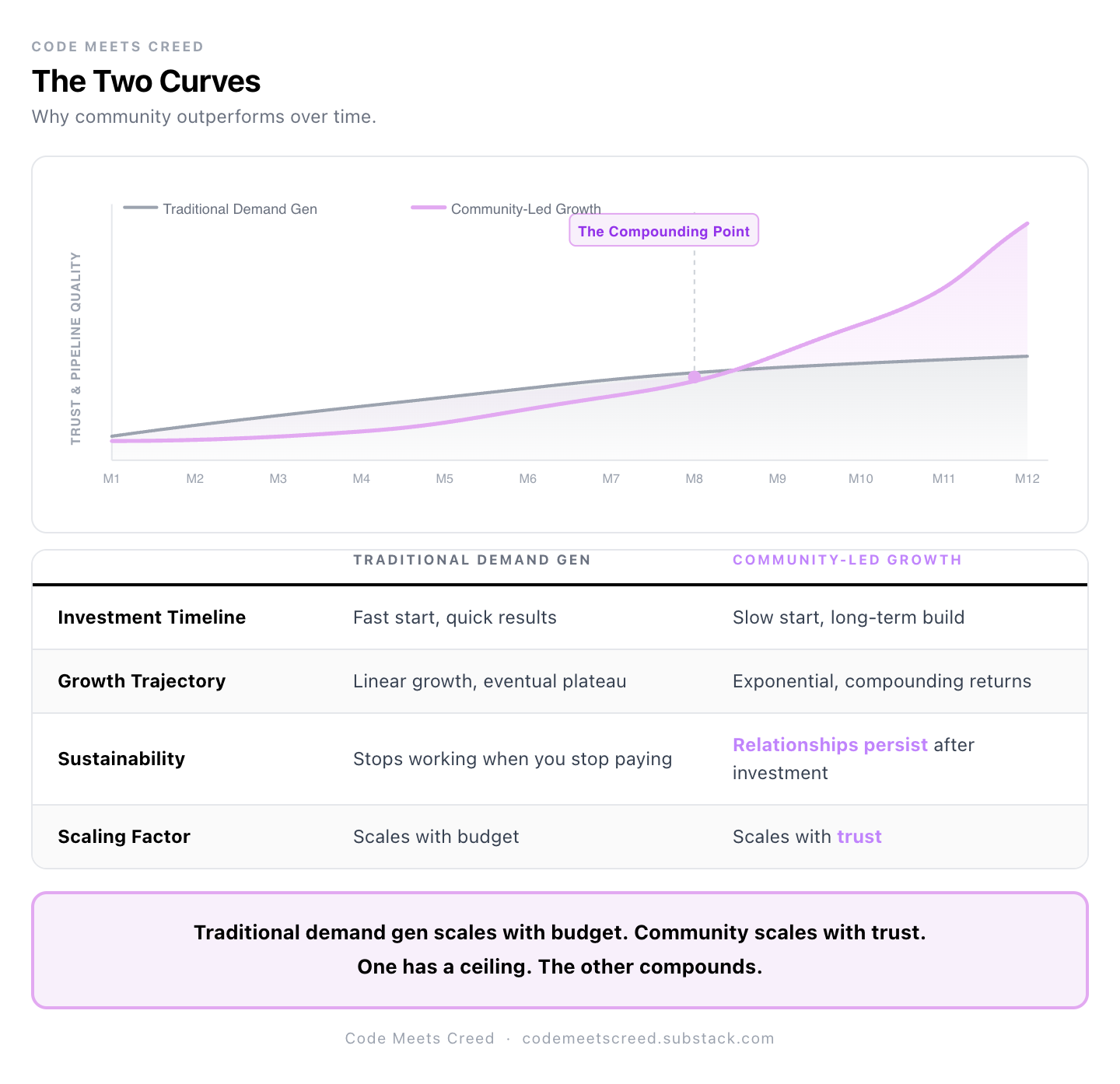
Traditional demand generation grows linearly and then plateaus. You can scale it with budget, but the efficiency tends to erode as the market gets more saturated, audiences get more fatigued, and the next dollar of spend produces less than the last.
Community-led growth compounds. Slowly at first (painfully slowly, sometimes) and then exponentially. The reason is that relationships, unlike campaigns, don’t reset. The trust you build with a community member in month three is still there in month eighteen. The introduction they make for you in month twelve happens because of everything that came before it. The deal they pull you into in month twenty is the compounding return on every touchpoint that preceded it.
There is a crossover point — I think of it as the compounding point — where the community-led curve crosses the traditional demand gen curve. Before that point, traditional demand gen looks more efficient. After it, community-led growth produces returns that demand generation simply cannot replicate.
The challenge for most marketing leaders is that the pressure they’re under is for results now — this quarter, this half, this year. Building community requires being willing to invest through a period of apparent underperformance in exchange for compounding returns that will be harder to attribute but more durable than anything a campaign can produce.
The companies that navigate this well tend to have one thing in common: a leadership team that understands the distinction between media buys and capital investments, and is willing to treat community as the latter.
Where Most Companies Are Getting It Wrong
In my B2BMX talk, I introduced a spectrum of how companies actually participate in community, from worst to best.
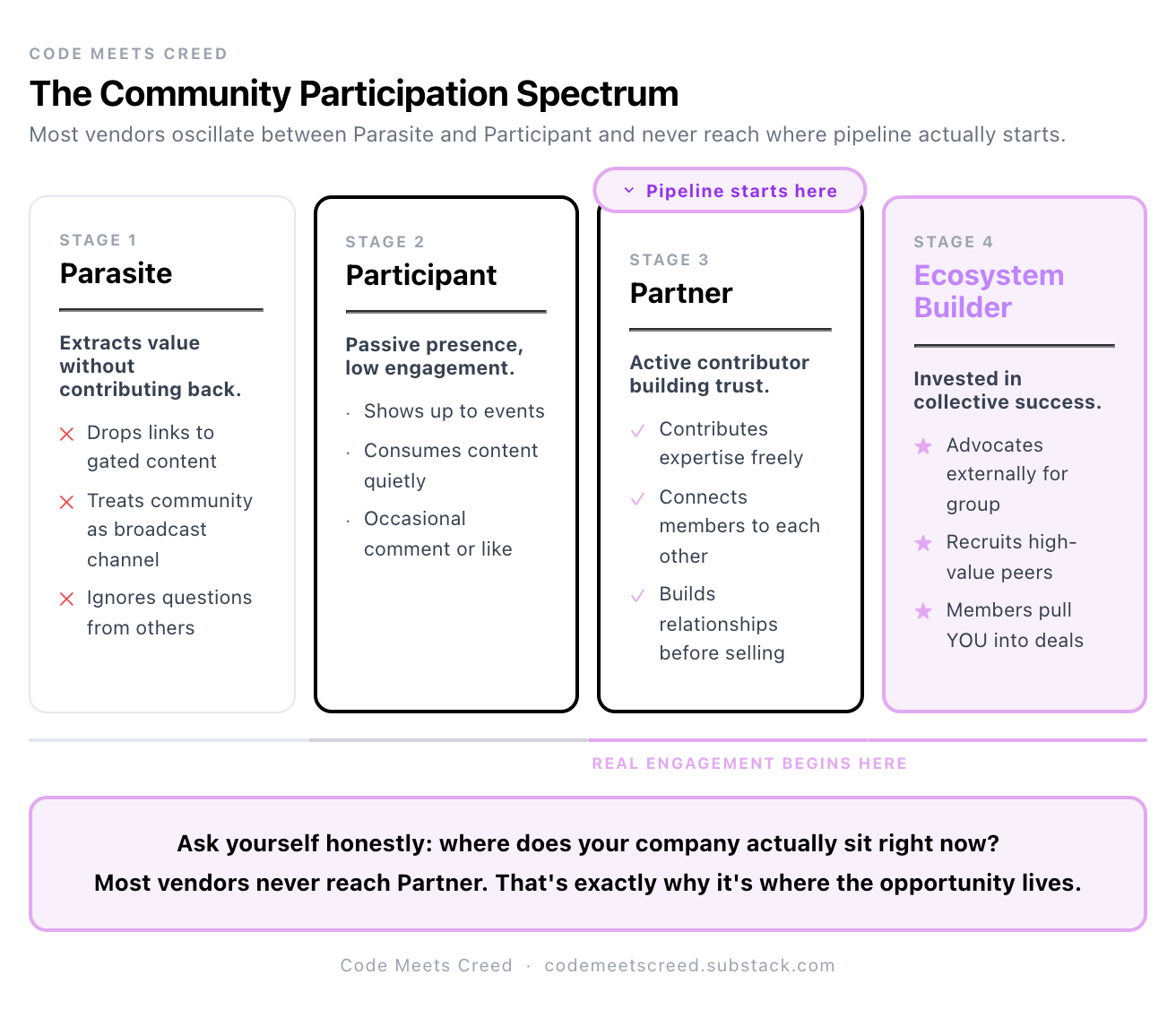
Most vendors oscillate between the bottom two modes and never reach the ones where value actually accrues.
The Parasite extracts value without contributing back. Drops links to gated content in discussions. Treats the community as a broadcast channel. Ignores questions from other members. Shows up only to take. I’ve seen countless vendors do this at Pavilion and in other communities where I’m a member — and the community members notice immediately. The Parasite gets nothing from the community because the community gives them nothing, which is exactly what they deserve.
The Participant is passively present but low-engagement. Shows up to events. Consumes content. Occasionally likes or comments. This is where most companies that care about community actually live — not actively extracting value, but not contributing meaningfully either. The Participant exists, they’re just not memorable.
The Partner is an active contributor building real trust. Contributes expertise freely, without a hidden agenda. Connects members to each other. Builds relationships before attempting any commercial conversation. Real engagement begins here. Pipeline begins to become possible here. The Partner is the company that other members talk about positively when the company isn’t in the room.
The Ecosystem Builder is invested in the collective success of the community. Advocates externally for the community itself — not just for their own brand. Recruits high-value peers into the community. Has members who actively pull the company into deals and introductions. This is where the compounding returns really live, and it takes time to get here, which is exactly why so few companies ever do.
Ask your team: where do we actually sit on this spectrum? Not where we aspire to be, but where we actually are — right now, in the specific communities where we participate.
Most companies, if they’re honest, sit between Parasite and Participant. The gap between where they are and where the value lives is the strategic opportunity.
The Three Currencies
I want to offer one more framework before I get into what we’re building at Sequel, because I think it’s the most useful lens for understanding why community-led growth works at a fundamental level.
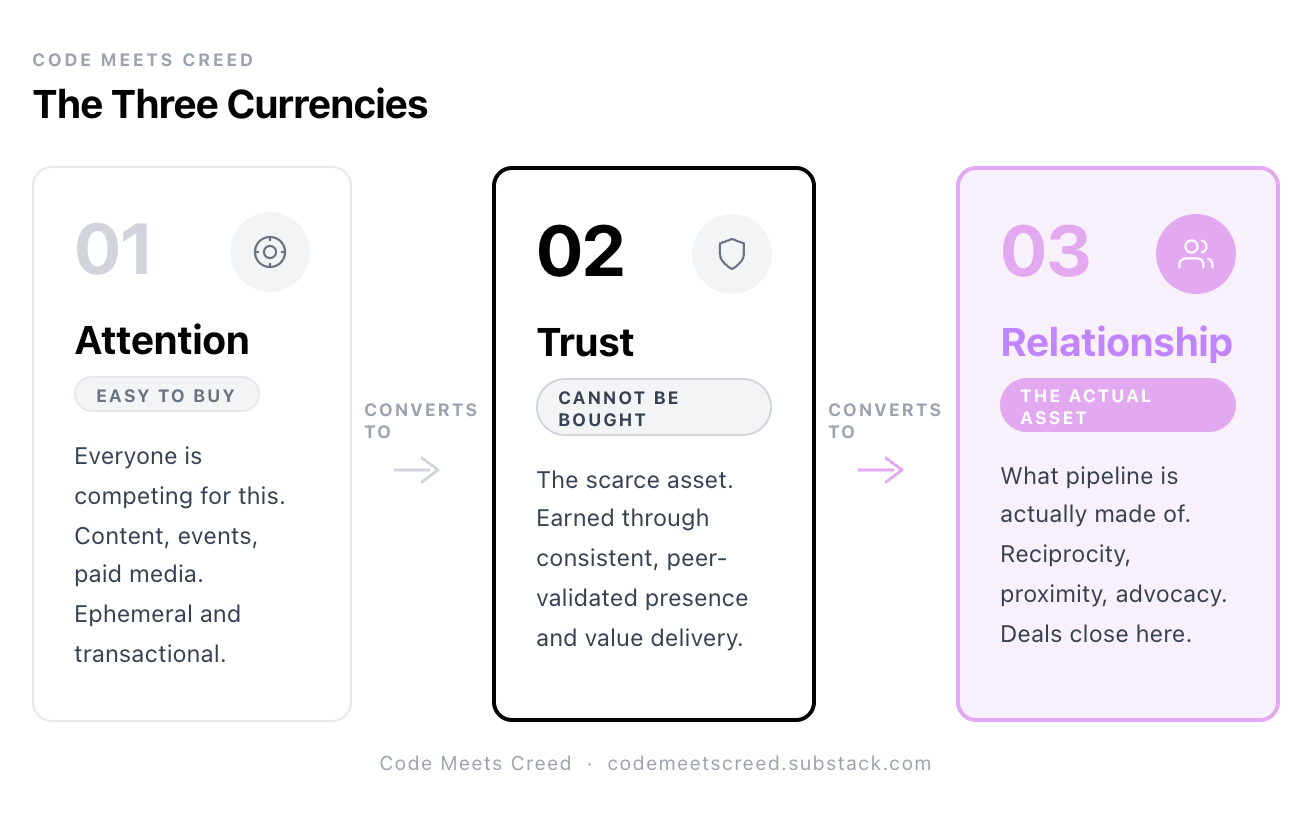
There are three currencies in B2B marketing. They don’t convert to each other automatically — you have to earn your way from one to the next. And most companies get the progression wrong.
Attention is the first currency, and the easiest to buy. Content, events, paid media, outbound — all of these generate attention. Everyone is competing for it. It’s transactional, and when you stop paying for it, it stops arriving.
Trust is the second currency, and it cannot be purchased. It is the scarce asset in B2B marketing right now, and it’s getting scarcer as buyers become more skeptical of vendor-generated content and more reliant on peer validation. Trust is earned through consistent presence, genuine value contribution, and peer-to-peer endorsement over time.
Relationship is the third currency, and it’s what pipeline is actually made of. Not the Salesforce object, but the actual human thing — the reciprocity, the proximity, the advocacy, the moment when a buyer who has been part of your community introduces you into a deal you didn’t know existed.
The fatal mistake that most companies make is trying to skip from Attention directly to Opportunity. They get someone’s attention — an ad click, a webinar registration, a conference badge scan — and immediately route them into a sales sequence designed to convert them into pipeline. This is why response rates are falling. Buyers can feel when they’ve been mistaken for a lead rather than recognized as a person.
Community is the bridge from Attention to Trust.
It’s the structured system for moving someone from “I’ve heard of this company” to “I trust this company enough to recommend them to my network.” And that bridge — that trust — is what makes commercial conversations feel natural rather than transactional.
Build attention. Convert it to trust through community. Let trust create relationships. Let relationships produce pipeline.
That’s the sequence. Everything else is execution.
How I’m Thinking About Community at Sequel
When I joined Sequel, I came with a clear belief about what our go-to-market motion needed to be. We’re in a crowded market — webinar and virtual events platforms — dominated by large, well-funded, legacy players. We’re never going to outspend them. What we can do is out-trust them.
Our community strategy is built around a media brand called Game Changers, and it has two tiers designed for two distinct audiences.
The Game Changers CMO Series brings together accomplished chief marketing officers for live, interactive conversations about what’s actually on their minds — the strategic challenges, the market forces, the things that keep them up at night. These are virtual, hosted on Sequel’s own platform, and deliberately positioned as peer-to-peer conversation rather than vendor content. Sequel might be a supporting character in some of these stories. It’s never the main character.
The Game Changers Masterclass is for the director-level practitioner — the person running demand generation, managing the webinar program, executing the tactics. The format is more tactical, more interactive, and more focused on how things actually get done on a day-to-day basis.
Both programs feed into the same community. Everyone who participates — as a guest or an attendee — gets access to all of it: the events, the dinners, the roadshow workshops, and the ongoing programming we’re creating.
The bridge between virtual and in-person is where the magic happens. The virtual events allow us to create scale while providing helpful data (thanks to the Sequel Score baked into Sequel’s Audience Insights) about who’s showing up repeatedly, who’s engaging in chat, and who’s attending on demand after the live event.
From that pool, we select participants for intimate in-person experiences including CMO dinners and workshop-style Masterclass sessions that are all a part of our Intelligent Website Roadshow. These are small rooms where the group can have off-the-record conversations, and where there is no pitching allowed.
The goal is depth of relationship, not breadth of coverage.
This bridge between virtual and in person, combined with careful curation of who is in the room and clear expectation setting about what can (and more importantly, cannot) be discussed, is the thing that creates trust and keeps people coming back for future events.
How Communities Actually Get Built
I want to get practical for a moment, because I think the strategic case for community is well-made at this point and the question most marketers are actually sitting with is: how do you start?
The answer is less impressive than most people want it to be.
You start with friends and family.
Every community I’ve seen become something real — Pavilion, the marketing community I helped build at IMPACT when we had 5,000 members in a Facebook group, Game Changers at Sequel — started the same way. You identify who you want the community to be for, and then you recruit the best possible version of that person from your existing relationships. Not through outreach — through warmth and trust.
The people you start with set the tone for everyone who comes after.
Who’s in the room in the early days sends a signal to every person who joins later about what kind of community this is and who it’s for.
If you compromise on that early because you need the numbers, you compromise the community. If you hold the standard, the later growth tends to reflect it.
The community starts working when members begin taking ownership, not when you have a certain number of members or a certain engagement rate. When a member in your Slack starts correcting another member who’s violating community norms, when someone volunteers to co-host an event in their city, or when someone introduces two other members to each other without being asked — that’s the flywheel starting to turn. That’s when you know you have something.
At Pavilion, I was one of those members before I was ever an employee. I became the Washington DC chapter head because I believed in what the community was doing and wanted to contribute to it. That kind of membership — where people associate their professional identity with belonging — is what community-led growth is actually about.
It doesn’t happen fast, it doesn’t scale linearly, and it cannot be manufactured by a campaign.
But when it works, it produces the kind of trust that compresses sales cycles, increases win rates, and generates referrals that no amount of paid media can replicate.
The Question Every Marketing Team Should be Asking
At B2BMX, I ended my talk with a reframe I want to leave you with here as well.
The wrong question is: How do we generate leads from this community?
The right question is: Are the right people getting closer to us?
The distinction is important. The first question treats community as a channel — a distribution mechanism, a lead source, or a line item on the marketing plan. The second question treats community as a trust engine — a long-term investment in future pipeline
Most B2B companies are asking the first question. The ones building real competitive advantage are asking the second. And the ones asking the second question are the ones whose pipelines, twelve to eighteen months from now, will be full of relationships that nobody can replicate by simply spending more on paid media.
Community doesn’t replace the commercial conversation — it’s what earns you the right to have it.
The Part AI Cannot Do
I’ll close by coming back to where I started. Community is the clearest expression I know of what the Creed side of Code Meets Creed is actually about.
AI can help you find the right people. It can help you analyze engagement data to identify who’s showing early signs of becoming an evangelist. It can help you generate content from your event transcripts, surface insights across hundreds of conversations, and personalize follow-up at scale. I use all of these capabilities at Sequel, and I’ll write more about how in future issues.
But the judgment about who belongs in the room, the decision to hold the standard on early membership even when the pressure is to grow faster, the consistent presence that earns trust before asking for anything in return, the moment when you feel a member starting to take ownership of something that isn’t theirs — and you recognize it for what it is — those are human things. They always will be.
Build proximity. Trust will follow, and when you have trust, pipeline is inevitable.
That’s the creed.
A note on my content:
Yes, I use AI to help me write this newsletter. Every idea, insight, and point of view here is mine. AI helps me think, structure, and draft — it does not replace my judgment. I also use em dashes (and emojis 👀) unapologetically, sometimes because AI likes them, and sometimes because they’re grammatically correct. If you’re here to sniff out “what was written by AI,” you’ll probably be disappointed. And if you’re fundamentally against the use of AI in writing, this newsletter is likely not for you. You’ll find this disclaimer in every issue, because transparency matters to me.